

Best Critical Care Hospital in Kerala
Expert Intensive Care, Every Hour of Every Day, for the Moments That Decide Everything
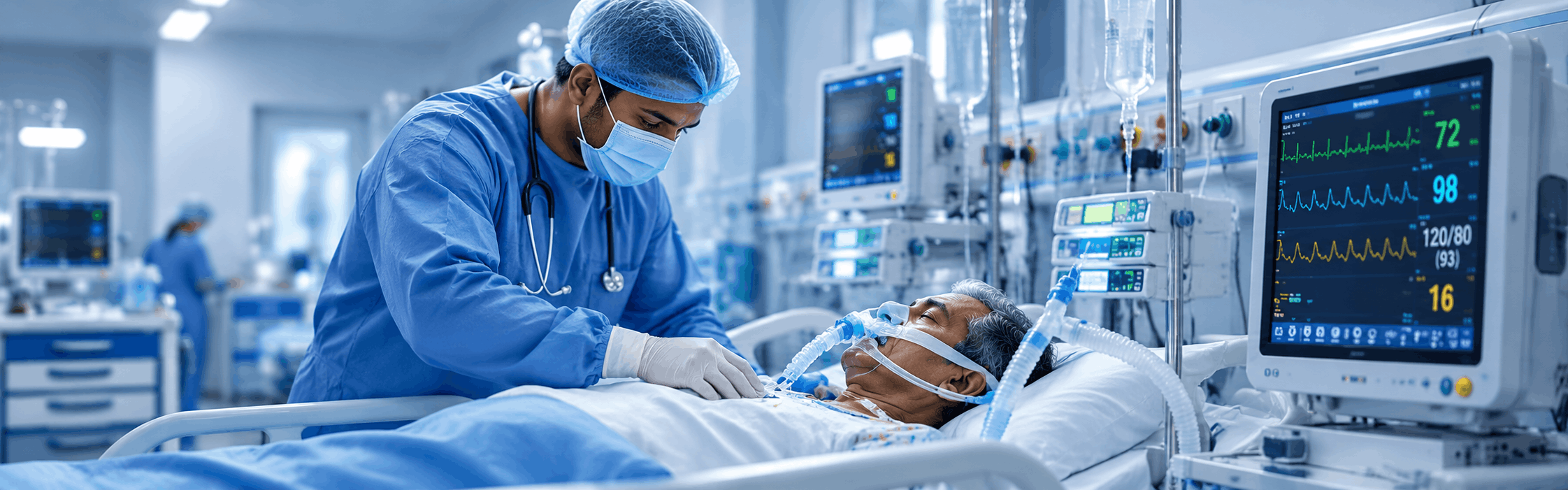
The Critical Care Department at SP Fort Hospital, Trivandrum is where the hospital's most urgent work is done. Our Intensive Care Unit and Coronary Care Unit are staffed and equipped to hold a patient through the hours when the body is failing faster than it can recover, whether that is multi-organ failure, a severe infection, a heart attack, a stroke, or major trauma. Care here is delivered by intensivists, critical care nurses, and allied specialists who are present in the unit, not on call from elsewhere.
Critical illness moves quickly, and the difference between recovery and deterioration is often measured in minutes rather than days. Every bed in our unit is continuously monitored, and reviewed each and every patients several times a day. Our emergency team, operating theatres, and laboratory all sit within the same building facilitating hand on hand services . For families across Thiruvananthapuram and the southern districts searching for an advanced critical care hospital Kerala can rely on in an emergency, SP Fort is a lifeline that has been in place for over 27 years. Critical care in Kerala is not simply about equipment. It is about the people watching the monitor at three in the morning.
Why the First Few Hours Decide the Outcome
Most people never think about an intensive care unit until they need one, and by then there is no time to compare hospitals. A critically ill patient does not have a single problem to be solved. They have several, all of them interacting, all of them changing hour by hour. Blood pressure falls, the kidneys respond, the lungs stiffen, the heart strains, and each of those events makes the next one more likely. This is why an intensive care unit in Kerala must be judged on more than its bed count. What matters is whether a trained intensivist is physically present, whether the nursing ratio allows a nurse to actually watch the patient, whether the laboratory can turn around a blood gas in minutes rather than hours, and whether the surgical and cardiology teams can be at the bedside immediately when the picture changes. SP Fort is regarded as the best hospital for critical care in Kerala because all of those things are true here at the same time. The other half of critical care is the part that is rarely discussed. Somebody has to explain to a family what is happening, what is being done, and what the realistic range of outcomes is, in language they can absorb while they are frightened. Critical care services in Kerala often fall short here, and we have made structured daily family communication a fixed part of our protocol rather than something that happens when a doctor has a spare moment.
When Critical Care Is Needed
Severe breathlessness or oxygen levels that will not hold. Persistent low blood pressure. Confusion, drowsiness, or unresponsiveness. Chest pain with an abnormal ECG. A fever with a rapid pulse and a falling urine output. A seizure that does not stop. Suspected poisoning or overdose. Major injury after a road accident or a fall. Deterioration after surgery. Any of these can escalate within hours. Intensive care services Kerala patients need are not a last resort to be reached for once everything else has failed. Early admission to an ICU, before the organs are exhausted, is consistently associated with better survival than a late one.
Care That Continues After the Unit
Leaving the ICU is not the end of critical illness. Patients step down to our high dependency and ward beds under the same consultant team, with rehabilitation, nutrition, and follow-up planned before discharge rather than after it. As a hospital for critical patient Kerala families can stay with through the whole recovery, our involvement runs from the ambulance to the outpatient review months later.
Meet Our Intensivists and Critical Care Team

Why Patients Choose the Hospital with Best Critical Care Department in Kerala
An intensive care unit is judged in its worst hour, not its best. SP Fort is considered the hospital with best critical care department in Kerala because of what happens when a patient arrives unstable at two in the morning and every minute counts.
Intensivists Present in the Unit, Around the Clock
A critical care specialist in Kerala is only useful if they are in the building. Our intensivists, anaesthesiologists, cardiologists, and critical care nurses are physically present through the night, so decisions are made at the bedside rather than over a phone call.
A Full Multidisciplinary Team on One Floor
Cardiology, neurology, nephrology, pulmonology, gastroenterology, and surgery are all in-house and reach the bedside within minutes. This is what makes SP Fort a genuine multi specialty ICU hospital Kerala patients can be brought to with any presentation, rather than a unit that must transfer out when the diagnosis turns out to be something else.
Monitoring That Does Not Blink
Every bed is continuously monitored and networked to a central station, so a change in rhythm, pressure, or saturation is seen the moment it happens. As a hospital with advanced ICU facilities Kerala has few equivalents to, our surveillance is designed to catch deterioration before it becomes an arrest.
Coronary Care Expertise
Our Coronary Care Unit manages myocardial infarction, dangerous arrhythmias, heart failure, and recovery after cardiac intervention under continuous rhythm monitoring. Cardiac critical care in Kerala at SP Fort is supported by a catheterisation service and a cardiology team on site.
Diagnostics at the Bedside
Point-of-care blood gas, electrolytes, cardiac markers, bedside ultrasound, and echocardiography mean the patient is assessed where they lie. Nobody unstable is moved down a corridor for a test that could have been brought to them.
Seamless Emergency Response
Ambulance support, resuscitation on arrival, and immediate transfer into the unit run as a single pathway. For a family searching for a critical care hospital near me Kerala can respond fast, that unbroken chain from the door to the ICU bed is the entire point.
Infection Control Taken Seriously
Critically ill patients are immunologically vulnerable, and a hospital-acquired infection can undo weeks of progress. Our units are built and run to strict infection control standards, with audited hand hygiene, line care, and ventilator bundles.
NABH Accreditation
Our clinical standards, safety protocols, and record-keeping are audited against national benchmarks. For anyone assessing which is the best ICU hospital in Kerala, accreditation is one of the few claims that can be independently verified.
Conditions We Diagnose and Treat in Intensive Care
Our unit manages the full range of life-threatening adult illness, medical and surgical. Some patients are with us for a night of observation after surgery. Others are with us for weeks while their organs recover one system at a time.
Multi-Organ Failure
When two or more organ systems fail together, each one destabilises the others, and treatment has to hold all of them at once. Multi organ failure treatment in Kerala at SP Fort combines ventilation, circulatory support, renal replacement, and metabolic correction under a single consultant team, so the plan is coordinated rather than assembled from competing opinions.
Respiratory Failure and ARDS
When the lungs can no longer move enough oxygen into the blood, the window for intervention is narrow. Respiratory failure treatment in Kerala here covers oxygen therapy, non-invasive support, and full mechanical ventilation with lung-protective settings. ARDS treatment in Kerala at SP Fort follows current international protocols, including proning and careful fluid management, because the way a ventilator is set determines whether the lung heals or is further injured.
Sepsis and Septic Shock
Sepsis kills more people than most cancers and it does so quickly, which is why every hour of delay in antibiotics measurably increases mortality. Sepsis treatment in Kerala at SP Fort runs on a time-bound protocol of cultures, early antibiotics, fluid resuscitation, and source control. Septic shock treatment in Kerala adds vasopressor support and invasive haemodynamic monitoring, delivered in a unit where the whole sequence can begin within minutes of arrival.
Stroke and Neurological Emergencies
In stroke, brain tissue is lost by the minute, and the treatment depends entirely on whether the vessel is blocked or bleeding. Stroke critical care in Kerala at SP Fort begins with immediate imaging and neurology assessment, followed by intensive monitoring of pressure, sugar, and oxygenation. Neuro critical care in Kerala also covers status epilepticus, meningitis and encephalitis, raised intracranial pressure, and recovery after neurosurgery.
Severe Trauma and Accident Injuries
Major injury rarely affects one system alone. Critical trauma care in Kerala at SP Fort brings emergency medicine, surgery, orthopaedics, and intensive care together from the moment the patient arrives, so that bleeding, breathing, and brain injury are addressed in the right order rather than in sequence.
Poisoning and Drug Overdose
These patients can look stable and then deteriorate suddenly as the substance is absorbed. Poisoning critical care in Kerala at SP Fort covers stabilisation, decontamination where appropriate, antidotes where they exist, and organ support while the body clears the agent. Drug overdose treatment in Kerala includes airway protection, cardiac monitoring, and psychiatric review before discharge, because the medical crisis is usually not the whole problem.
Ventilator and Life Support
For a patient who cannot breathe adequately on their own, mechanical ventilation buys the time the lungs need. As a ventilator support hospital Kerala families are directed to for the most difficult cases, we manage both short-term ventilation and prolonged weaning, and life support treatment Kerala patients receive here is reviewed daily against clear clinical goals, with liberation from the ventilator pursued as early as it is safe.
Post-Operative and High-Risk Surgical Care
Complex surgery does not end in the theatre. Post surgery ICU care in Kerala at SP Fort covers the first critical hours after cardiac, neurosurgical, major abdominal, orthopaedic, and emergency trauma procedures, when bleeding, pain, fluid balance, and infection all need close control.
Geriatric Critical Illness
Older patients decompensate faster, tolerate less, and carry more coexisting disease. Their care requires a physician who understands frailty and can weigh the burden of an intervention against its likely benefit, and this judgment is at the centre of how we treat every elderly patient in the unit.
Critical Care Services at SP Fort Hospital
Intensive Care Unit
A fully monitored, intensivist-led unit for patients with life-threatening medical illness. Widely regarded as the best intensive care unit in Kerala for medical emergencies, it is staffed continuously and supported by every specialty in the building.
Emergency Resuscitation and Ambulance Support
Rapid ambulance response, resuscitation on arrival, and a direct route into the unit without administrative delay. Patients searching for an ICU hospital near me Kerala can reach quickly will find our emergency department open at every hour.
Perioperative and Post-Surgical Critical Care
Planned intensive care after high-risk surgery, including cardiac, neurosurgical, major abdominal, orthopaedic, and emergency trauma procedures. As the best hospital for post surgery ICU care Kerala surgeons refer into, our team is involved before the operation, not summoned after it.
Step-Down and Recovery Care
High dependency beds, physiotherapy, nutrition support, and structured discharge planning, so that recovery continues under the same team that carried the patient through the acute phase.
Family Communication and Counselling
Scheduled daily updates from the treating consultant, honest explanation of prognosis, and support for families making difficult decisions. This is a service, and we treat it as one.
The Infrastructure Behind Every Hour of Intensive Care
Equipment does not save a life on its own, but its absence can cost one. Everything our team needs is at the bedside, in the unit, at every hour.
Fully Networked ICU Beds with Smart Monitoring
Every bed streams to a central station, so a single change in a single patient is visible to the whole team instantly. This is the backbone of what makes SP Fort an ICU equipped hospital Kerala clinicians trust with the sickest patients.
Advanced Mechanical Ventilation
Modern ventilators supporting invasive and non-invasive modes, lung-protective strategies, and structured weaning protocols for patients who need prolonged support.
Non-Invasive Cardiac Output Monitoring
Continuous haemodynamic data allows fluids and drugs to be titrated to the patient's actual circulation rather than to an estimate.
Point-of-Care Laboratory Diagnostics
Blood gases, electrolytes, lactate, and cardiac markers are resulted in minutes within the unit, so treatment is adjusted on current numbers rather than old ones.
Bedside Ultrasound and Echocardiography
Cardiac, lung, and abdominal imaging performed where the patient lies, without moving an unstable patient anywhere.
Centralised Multi-Patient Surveillance
A single monitoring system covering every bed in the unit, designed so no alarm goes unseen. It is one of the reasons SP Fort is described as the best ICU care hospital Kerala families turn to in a crisis.
Infection Control by Design
Each ICU and CCU is built for patient safety, privacy, and infection control, with audited protocols governing every line, tube, and ventilator circuit.
From Emergency Arrival to Recovery
Critical illness is disorienting for families as well as patients. This is what happens, in order, so that you know what to expect.
1. Arrival and Immediate Assessment
Whether by ambulance or on foot, an acutely unwell patient is assessed and stabilised on arrival. Airway, breathing, and circulation are secured before anything else is considered.
2. Admission to the ICU or CCU
If intensive care is needed, the patient is moved directly into a monitored bed. As a leading critical care hospital Kerala relies on for emergencies, we do not hold unstable patients in a queue.
3. Diagnosis and Organ Support
Bedside investigations, imaging, and point-of-care laboratory results establish the cause while ventilation, circulatory support, or dialysis stabilise the patient in parallel. Diagnosis and treatment happen together, not one after the other.
4. Daily Consultant Review and Family Briefing
Your treating intensivist reviews the patient several times a day and speaks to the family at a set time, explaining what has changed, what is planned, and what remains uncertain.
5. Step-Down, Recovery, and Discharge
As the patient improves, they move to high dependency and then to the ward under the same team, with physiotherapy, nutrition, and a written follow-up plan arranged before they go home.
Frequently Asked Questions
When one or more organ systems can no longer function without support, or when deterioration is likely and needs to be watched for continuously. Severe breathlessness, low blood pressure, confusion, a serious infection, chest pain with ECG changes, or major injury are all reasons to be assessed urgently. Anyone searching for the best hospital for critical patients in Kerala should not wait for certainty before coming in.
Speak to Our Critical Care Team
Our emergency department and intensive care unit are staffed every hour of every day. If you believe someone is seriously unwell, call us now rather than waiting for the morning.