

Best Hospital for Heart Attack Treatment in Trivandrum
When a clot seals a coronary artery, the muscle it fed is starved from that second onward. It does not fail all at once. It dies in stages, and the size of the scar left behind depends almost entirely on how fast somebody reopens the vessel. Our cardiac emergency service is organised around that one number and very little else.
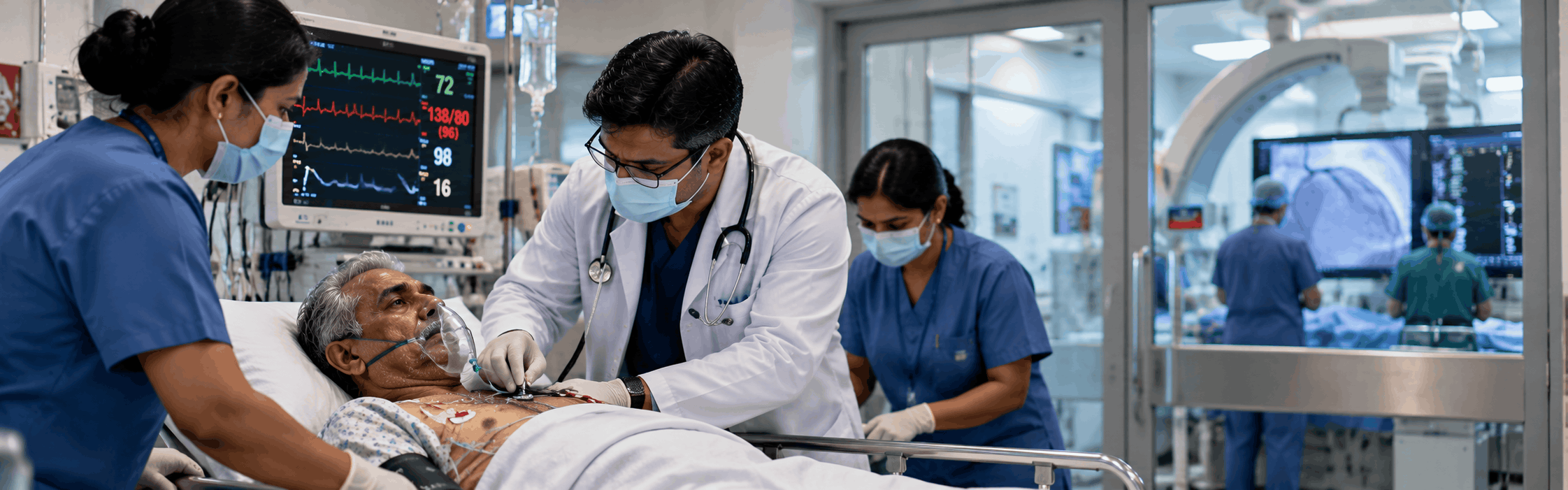
In practical terms, heart attack treatment should mean the casualty team, the cardiologist, and the catheterisation laboratory acting on one alert rather than passing the patient along a chain. When a family is looking for the best hospital for heart attack treatment in Trivandrum with a relative doubled over beside them, what they actually need is one number to call and a team already moving before the car pulls in.
The Cardiology Team

The Heart Does Not Grow New Muscle
Roughly a quarter of the threatened muscle is gone inside the first hour, and most of the remainder by the sixth. Open the artery quickly, and the heart usually recovers its strength. Open it late and the person survives with a pump that has permanently lost power, which shows up years later as breathlessness on a slope and a shelf full of medication. What separates those two futures is rarely the hospital chosen. It is the delay before anybody makes the call. For that reason, emergency cardiac care should be judged on stopwatch discipline rather than on the brochure. Angiography suites are common now. What differs between hospitals is whether the ECG happens in the first ten minutes, whether the cardiologist is woken before the diagnosis is certain, and whether the laboratory is already being opened while the ambulance is still on the road.
The Warning Signs People Explain Away
Almost every patient who arrives late had a reason for waiting. It felt like gas. It was only the shoulder. The walk home was tiring, but it had been a long day. Diabetics, older people, and women very often get no crushing chest pain at all, just sudden fatigue, sweating, or breathlessness. Searching for left side chest pain treatment at midnight and deciding to see somebody after breakfast is the exact pattern that costs muscle.
Most Chest Pain Is Not a Heart Attack
Acid reflux, a strained muscle, anxiety, and lung infections all hurt in the same place, and the majority of people we assess are sent home reassured. That is the system working. Sound chest pain treatment starts with an ECG and a blood test that between them take a few minutes, and being wrong about your heart in a waiting room costs you an evening, while being wrong at home can cost considerably more.
Seven Reasons Families Choose This Hospital in a Crisis
Cardiac emergencies are won on logistics. We are used as a best cardiac hospital in Trivandrum option for emergencies because of the seven arrangements below, all of which are crucial, and all of which are the reason people walk out.
One Alert Reaches Everybody
A single call to the emergency line wakes the casualty team, the duty cardiologist, and the laboratory staff simultaneously. By the time the patient is through the door, the room upstairs is ready.
The ECG Comes Before the Paperwork
Anybody who says the words chest pain gets an ECG straight away, ahead of registration, billing, and questions. That single rule finds more heart attacks in time than any scanner in the building.
Nights and Sundays Are Covered
Interventional cardiologists, and trained nurses are rostered around the clock, which is what makes a 24-hour heart emergency hospital different from one that can hold you until the morning list.
The Artery Is Opened Mechanically
When the ECG confirms a blockage, our default is to open it with a balloon and a stent rather than depend on clot-dissolving drugs. Emergency angioplasty restores flow far more dependably, and we perform it here instead of stabilising you for a journey elsewhere.
Surgeons Are Upstairs, Not Across Town
A minority of patients turn out to need bypass surgery, and a few deteriorate on the table. Surgical cover inside the same building removes the transfer that those particular patients cannot survive.
Cardiology Runs the Intensive Care
Dangerous rhythms and pump failure appear in the hours after the artery is opened rather than during the procedure. Monitored beds under cardiology supervision cover precisely that window.
A Whole Hospital Sits Behind the Heart Unit
Diabetes, kidney disease, and stroke travel with coronary disease in most of the people we admit. Being a multi-speciality cardiac hospital means those are treated in parallel rather than referred on once the heart is settled.
The Emergencies That Come Through These Doors
A cardiac emergency is not one condition. These are the presentations we see, and how each is handled.
Heart Attack With ST Elevation
The artery is shut completely, and the first ECG shows it. This is the most time-critical emergency in medicine, and the patient goes straight to the laboratory. Best treatment for heart attack of this kind is counted in minutes saved, not in techniques listed.
Heart Attack Without ST Elevation
A partly blocked vessel doing its damage more slowly. Blood markers and monitoring make the diagnosis, medication comes first, and an angiogram follows within the same admission.
Unstable Angina
Pain arriving at rest, or arriving sooner and staying longer than it used to, means a vessel is closing down. Treated at this stage, the heart attack never happens, which makes it the most valuable appointment a person can keep.
Narrowed Coronary Arteries
Stable narrowing that bites only on exertion is worked up with a treadmill test, an echocardiogram, or a CT angiogram. Heart blockage treatment then follows what the anatomy shows, which may be tablets, a stent, or surgery.
Chest Pain That Cannot Be Cleared Yet
Some patients look normal on the first ECG and the first blood test and are still having a heart attack. Those people stay for repeat testing rather than going home to find out. A doctor for chest pain worth seeing is one willing to keep you for a few hours.
Rhythm Disturbances
Hearts that race, stall, or beat chaotically cause blackouts, breathlessness, and arrest. Treatment runs from drugs and electrical cardioversion through to temporary and permanent pacing.
Sudden Heart Failure
Breathlessness that will not let a person lie flat, with frothy sputum and swelling, is an emergency by itself. Oxygen and fluid removal come first, then a hunt for whatever caused it.
Cardiac Arrest
Resuscitation, defibrillation, temperature control, and intensive care in that order, with the blocked artery addressed once circulation is back.
Conditions That Imitate a Heart Attack
Aortic dissection and pulmonary embolism both present with chest pain and are treated in completely different ways, one of which is made worse by the drugs used for the other. Separating them early is a core function of this service.
Problems Left Behind by an Earlier Attack
Weak pumping, damaged valves, arrhythmia, and blocked stents all follow previous events, and each carries its own pathway.
Cardiac Services That Continue After the Artery Is Open
The emergency service sits inside a working cardiology department, so treatment does not stop at the laboratory door.
Primary Angioplasty and Stenting
A balloon opens the vessel, and a drug-eluting stent holds it open, with flow restored during the procedure itself. Performed early, angioplasty treatment remains the most effective single intervention we have for a heart attack.
Planned Angiography and Intervention
Patients with stable symptoms or an abnormal stress test are studied on a scheduled list, and blockages are dealt with in the same sitting where that is appropriate. Stent placement treatment done to a plan carries considerably less risk than the same work done as a rescue at 4 am.
Complex and Repeat Procedures
Heavily calcified vessels, several blockages at once, previously stented segments, and disease at the left main artery are guided by intravascular imaging and pressure measurement rather than by the picture alone.
Pacemakers and Rhythm Devices
Temporary pacing, permanent devices, and lifelong device checks for the patients whose fault is electrical rather than a blockage.
Bypass and Valve Surgery
Performed in-house for the patients in whom a stent is the wrong answer, with the cardiologist and surgeon reaching that decision together over the angiogram.
Cardiac Intensive Care
Continuous monitoring, ventilation, and circulatory support through the days when complications tend to surface.
Cardiac Rehabilitation
Graded exercise, medication review, help with quitting smoking, and dietary work start before discharge. This is the part that prevents the second event, and it is the part most people quietly abandon in the third month.
Preventive Cardiology
Blood pressure, cholesterol, sugar, and family history reviewed together for people who have risk on paper but no symptoms yet. A heart health assessment done properly in your forties saves a great deal of trouble later.
What Is Switched On and Waiting
Emergency cardiology works only when everything sits in one building, and nothing needs to be woken from home. That is what lets advanced heart attack treatment begin within minutes of arrival, and it is why we serve as a best hospital for angioplasty in Trivandrum option for unplanned cases as much as for scheduled ones.
Catheterisation Laboratory
A flat-panel suite staffed at all hours, set up for coronary intervention, pressure wire studies, intravascular imaging, and temporary pacing.
Casualty With Cardiac Triage
Chest pain moves to the front of the queue, and the ECG machine and troponin analyser sit inside the department rather than in a laboratory two floors away.
Echocardiography and Cardiac Imaging
Bedside echocardiography, treadmill testing, Holter monitoring, and CT coronary angiography, all reported by cardiologists on site.
Cardiac Intensive Care Unit
Continuous rhythm monitoring, ventilators, defibrillators, and infusion support, run by the cardiology team rather than shared with the general unit.
Cardiac Operating Theatre
Bypass and valve surgery under the same roof, which is what removes the ambulance journey a deteriorating patient cannot afford.
Talking to the Ambulance Before It Arrives
An ECG can be discussed with our team while the patient is still moving, so the decision to bypass casualty and go straight upstairs is often taken before the vehicle reaches the gate.
From the Phone Call to the Front Door Again
Here is the sequence, from the moment somebody dials.
1. The Call
Say the words chest pain early in the sentence. It moves the call to the top and starts the team preparing. Where an ambulance can reach you, use one, because treatment starts inside the vehicle and a car has nothing on board.
2. The First Ten Minutes
An ECG is taken and read at once, blood goes for cardiac markers, aspirin and other medication are given, and monitoring begins. Registration is completed afterwards by whoever came with you.
3. The Decision
If the tracing shows a blocked artery, the patient goes straight up to the laboratory. If it does not, observation and repeat testing continue until the cause is established rather than assumed.
4. Opening the Vessel
Usually through the wrist, under local anaesthetic, with the patient awake and talking. Blood flow is typically restored within half an hour of entering the room.
5. Intensive Care and the Following Days
Rhythm and pumping function are watched closely, medication is settled, and an echocardiogram measures what damage was done. Uncomplicated patients usually go home on the third to fifth day.
6. Rehabilitation and Review
A supervised exercise and medication programme begins before discharge and carries on as an outpatient, with reviews at one month, three months, and then every year.
Frequently Asked Questions
Ambulance, every time. A heart can stop without warning in the first hour and there is nothing to be done about it in traffic. An ambulance carries oxygen, a defibrillator, and staff who can begin treatment on the move, and it can warn us that you are coming.
Put This Number in Your Phone Tonight
Nobody types cardiac emergency near me into a search bar in a calm frame of mind. By the time that search is happening, the minutes that matter are already being spent on it. Anyone who has ever looked up a heart hospital near me or a cardiac doctor near me for an ageing parent should save the number under that parent’s name and tell them where it is.