

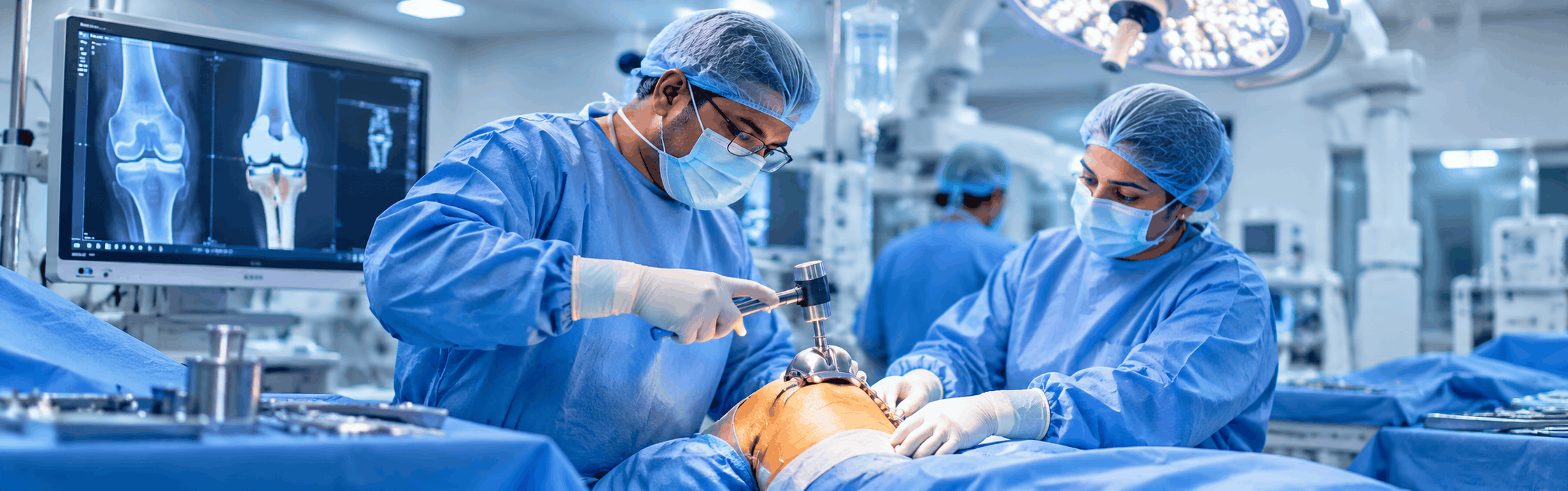
Best Hospital for Knee Replacement Surgery in Kerala
Some knees hurt only on the stairs. Others hurt getting out of a chair, kneeling to pray, and walking as far as the gate and back. At SP Fort Hospital, Trivandrum, our Department of Orthopaedics and Joint Replacement exists precisely for those knees. Surgeons, anaesthetists, physiotherapists, and rehabilitation nurses work from one shared treatment plan rather than sending patients between separate clinics.
Meet the Team

Chief Consultant - Orthopaedics
MBBS, MS(Ortho)


Consultant - Orthopaedics
MBBS, DNB, D.Ortho

Consultant - Orthopaedics (Spine)
MBBS, MS (Ortho), DNB, FNB (Spine), FSS (USA)


Consultant - Pediatric Orthopaedics
MBBS, MS


Consultant - Orthopaedics
MBBS, DNB(Ortho)

Why a Worn Knee Rarely Improves on Its Own
The knee is the largest weight-bearing joint in the body, and its working surfaces are covered by cartilage only a few millimetres thick. Once arthritis, injury, or inflammation wears that cartilage away, the body cannot rebuild it. Bone begins to rub against bone, the leg slowly bows, the thigh muscle weakens from disuse, and the limp that started as an occasional nuisance becomes the way you walk. CORRECT knee pain treatment begins with establishing what has failed inside the joint and how much of it remains usable. Not every painful knee needs surgery. The best treatment for knee pain may be weight reduction, physiotherapy, an injection, or medication while the joint surface is still largely intact. Our role is to tell you honestly which stage you have reached.
When Painkillers and Physiotherapy Have Stopped Working
Pain that wakes you at night, a walking distance that keeps shrinking, and tablets that no longer last the day are signs that conservative care has reached its limit. At that point severe knee pain treatment moves from management to repair, because the joint surface itself is the problem and no exercise can resurface it. A knee operation then stops being a last resort and becomes the treatment that restores function.
The Operation That Is Postponed Too Long
Many patients wait years, losing muscle, mobility, and independence while they wait. Delay makes surgery harder and recovery slower, because a weak thigh muscle and a stiff joint take longer to rehabilitate. Deciding at the right moment, rather than at the last possible one, produces the best long-term result.
Seven Reasons Patients Choose Our Knee Replacement Programme
An implant is a component. A programme is what makes it work. SP Fort has become a hospital for knee replacement in Kerala that clinicians refer to because the whole clinical picture is addressed, and that integration is what patients notice first.
One Team, One Plan
Your surgeon, anaesthetist, and physiotherapist assess you together and agree on a single plan. Nobody is left carrying films between departments hoping the advice will match.
Surgeons Who Do This Every Week
Volume and consistency matter in joint replacement. The best knee replacement surgeon is the one who performs the operation routinely rather than occasionally, and that regularity shows in operating time, blood loss, and complication rates. Our team operates on knees every week of the year.
Implant Selection Matched to You
Age, bone quality, deformity, activity level, and anatomy decide the implant, not habit. Knee joint replacement at SP Fort draws on cruciate-retaining, posterior-stabilised, high-flexion, and constrained systems, so the choice fits the patient in front of us.
Infection Prevention Taken Seriously
Laminar flow theatres, exhaust suits, pre-operative screening, and strict antibiotic protocols reduce the one complication that can undo an excellent operation.
Pain Control Designed Before Surgery
Nerve blocks, spinal anaesthesia, and multimodal analgesia are planned in advance so that you can stand and walk within a day. Comfort is not an afterthought, because it is what makes early rehabilitation possible.
Rehabilitation Starts on Day One
Physiotherapy begins in the ward, not weeks later in an outpatient queue. The operation is half of the outcome, and rehabilitation is the other half.
Medical Support for Older Patients
Cardiology, diabetology, and internal medicine sit in the same building for patients who carry other conditions alongside a worn joint. This is why families regard us as the best hospital for knee surgery in Kerala for high-risk and elderly cases.
Knee Conditions We Treat with Surgery and Advanced Orthopaedic Care
Knee replacement is one answer among several, and it is prescribed for specific, well-defined problems. Below are the conditions our department treats, and how we approach each of them.
Knee Osteoarthritis
Age, weight, and old injury wear the joint surface until movement becomes painful and the leg begins to bow. Treatment starts with weight support, physiotherapy, and medication, and moves to replacement once the joint space has gone.
Rheumatoid and Inflammatory Arthritis
Inflammation destroys cartilage and bone from within, and it usually affects both knees. Medical control comes first, and we coordinate the surgical plan with rheumatology so that the operation is timed around disease activity.
Post-Traumatic Knee Damage
Old fractures around the knee leave uneven joint surfaces that wear out early. These patients often need reconstruction, bone grafting, or removal of previous plates and screws before the joint can be resurfaced.
Meniscus Tears and Ligament Injuries
A twisted knee that locks, gives way, or swells after activity may have a torn meniscus or a ruptured cruciate ligament. Knee joint damage treatment at this stage is usually arthroscopic and joint-preserving, which is exactly why an early diagnosis is worth having.
Bow Legs and Knock Knees
Deformity loads one half of the knee far more than the other and destroys it first. Correcting the alignment is part of the operation, and in selected younger patients an osteotomy can postpone replacement by years.
Stiff Knees and Loss of Bend
Some knees lose the ability to straighten fully or to bend enough for sitting cross-legged, using stairs, or getting into a car. Knee stiffness treatment can restore movement to a joint that has been rigid for years, and patients often find that change more life-changing than the pain relief.
Avascular Necrosis of the Knee
Interrupted blood supply causes a segment of bone at the end of the femur or tibia to collapse. Early cases may be salvaged, while collapsed surfaces need replacement with implants chosen for the patient’s age.
Failed and Loosened Previous Implants
Implants can loosen, wear, become stiff, or become infected years after the first operation. Revision is technically demanding, and it needs specific instruments, augments, stems, and experience that we maintain in-house.
Septic Arthritis and Infected Knees
Infection destroys a joint quickly and needs urgent washout, culture-directed antibiotics, and staged reconstruction. Delay here costs the joint permanently.
Kneecap Pain and Patellofemoral Problems
Pain at the front of the knee on stairs and slopes often comes from the kneecap rather than the joint surface as a whole. A knee specialist doctor should separate the two before any operation is discussed, because the treatments are entirely different.
Comprehensive Knee Pain Assessment
Not all knee pain comes from the knee. The hip, the lower spine, and vascular disease all refer pain to the same area, which is why our assessment examines them as well. That thoroughness is why patients come to us as an orthopaedic hospital for knee pain rather than only as a surgical unit.
Joint Replacement, Bone Health, and Rehabilitation Under the Same Roof
Knees rarely fail in isolation, so our wider orthopaedic services sit within the same department rather than behind a separate referral.
Total Knee Replacement
All three worn compartments are resurfaced with implants matched to your bone and activity level. Total knee replacement is the standard operation for advanced arthritis, and our patients follow a rapid recovery protocol that has them walking on day one.
Partial Knee Replacement
Where only the inner or outer half of the joint is worn, a partial replacement resurfaces that half alone. It preserves the ligaments, uses a smaller incision, and gives a quicker recovery in the right patient.
Both Knees in One Admission
Patients whose knees have failed together can have both replaced during a single admission, which means one anaesthetic, one rehabilitation programme, and one recovery instead of two. Fitness for total knee replacement surgery of this kind is assessed carefully before it is offered.
Revision Knee Replacement
Loosening, wear, instability, stiffness, and infection are managed with single-stage or staged revision. Surgery of this complexity is planned with detailed imaging and a full range of revision components on the shelf.
Arthroscopic and Ligament Surgery
Meniscus repair, cruciate ligament reconstruction, and cartilage procedures are performed for younger and sporting patients through keyhole incisions. Advanced knee surgery includes preserving a joint wherever preservation is still realistic.
Hip and Shoulder Replacement
The same team performs hip and shoulder arthroplasty, which matters for patients who have more than one worn joint and a sequence of operations to plan.
Osteoporosis and Bone Health Clinic
Bone density scanning, vitamin D and calcium correction, and medication reduce the risk of the next fracture. Any orthopaedic surgeon will confirm that treating the bone matters as much as treating the joint.
Rehabilitation and Physiotherapy
Supervised rehabilitation continues after discharge. Long-term knee joint care depends on it, and we treat follow-up as part of the operation rather than as an optional extra.
The Facilities Behind Our Knee Replacement Programme
Joint replacement rewards precision and preparation. SP Fort brings imaging, implants, and theatre standards together so that every procedure is planned accurately and delivered consistently. That combination is what makes advanced knee replacement surgery available close to home rather than only in metro centres.
Laminar Flow Modular Theatres
Ultraclean air handling, restricted traffic, and dedicated joint replacement lists reduce infection risk. This is the single most important piece of infrastructure patients should ask about when they compare hospitals.
Advanced Imaging and Diagnostics
X-ray, MRI, CT, and full-length alignment films are available on site, and they are usually completed during the same visit.
Modern Implant Systems
Cruciate-retaining, posterior-stabilised, high-flexion, unicompartmental, and revision systems are stocked, so the implant fits the patient rather than the patient fitting the stock.
Anaesthesia and Pain Management Services
Regional blocks, spinal anaesthesia, and tranexamic acid protocols reduce blood loss, pain, and the need for transfusion.
Dedicated Physiotherapy Gymnasium
Parallel bars, stair practice, cycling, and gait training are all in-house, so rehabilitation begins before discharge rather than after it.
From First Consultation to Walking Unaided
Patients who arrive after years of pain want to know what will actually be different here. This is the pathway, stage by stage.
1. Booking and First Visit
Call the front desk or use the online form to arrange a knee checkup in Kerala at a time that suits you. Bring your previous X-rays and scans, past prescriptions, and your current medication list.
2. Examination and Imaging
We examine movement, alignment, ligament stability, gait, and the hip and spine above the knee, and we take weight-bearing X-rays. Blood tests, cardiac assessment, and a dental review follow if surgery is likely.
3. Your Treatment Decision
The surgeon, anaesthetist, and physiotherapist explain the findings together, including whether replacement is needed now, later, or not at all. You will see the imaging yourself while they explain it.
4. Surgery and Inpatient Stay
A single knee joint replacement surgery at SP Fort typically takes around ninety minutes. Most patients stand and walk on the first day and go home three to five days after the operation.
5. Rehabilitation and Long-Term Review
Physiotherapy continues at home, with reviews at six weeks, three months, and then annually. We check implant position, bend, and bone quality at each visit.
Frequently Asked Questions
The cost depends on the implant selected, whether one knee or both are treated, and your room category, rather than on a single advertised figure. We issue written estimates after assessment, covering implant, theatre, stay, and physiotherapy, and our desk confirms what your insurance is likely to cover.
Speak to Our Knee Replacement and Orthopaedic Team
If you have been searching for a knee surgeon, our consultations run throughout the week and we accept emergency referrals at any hour. You can contact us on any of the following:
Emergency Care
+91 471 2466664
Front Desk
+91 471 2450540
info@spfort.com
Address
SP Fort Hospital, Fort P.O., Trivandrum