
Best Critical Care Hospital in South India
Intensive Care That Holds Its Standard for Week Three, Not Just Day One
Almost every hospital can look impressive on the first day of a critical illness. The equipment is new, the team is fresh, the family is reassured. The real test of an intensive care unit arrives later, in the second and third week, when the patient has not woken up, the ventilator has not come off, the infection has returned, and the money is running out. That is the point at which most families begin looking elsewhere, and it is the point at which they usually find us.
SP Fort Hospital in South India accepts critically ill patients from across Kerala, Tamil Nadu, Karnataka, and the wider region, including patients who have already spent weeks in another unit. As an advanced critical care hospital South India families turn to for the difficult middle of a critical illness, our work is not only the dramatic first hour. It is the slow, disciplined business of weaning a patient off a ventilator, clearing a resistant infection, and getting somebody home who was told they would not leave. Critical care in South India is not short of technology. It is short of patience.
The Two Questions Nobody Asks Until It Is Too Late
When a relative is admitted to intensive care, families ask about the machines and the doctors. Weeks later, the two questions that actually decide the outcome turn out to have been different ones. Can this unit get the patient off the ventilator. And can this family afford to stay long enough to find out. Both questions are avoidable, and both are worth asking on day one. An intensive care unit in South India should be able to answer each of them in a sentence, and the ones that cannot are usually the ones where the answers are unwelcome. Weaning a patient from life support is a slow, technical discipline that some units simply do not practise well, and a patient who could have been liberated in ten days can remain on a machine for two months in the wrong hands. Meanwhile, prolonged intensive care services South India can bill at rates that force families into decisions no family should have to make on financial grounds. We think both of these are solvable problems, and we have built our department around solving them. SP Fort is regarded as the best hospital for critical care in South India by referring physicians not because our equipment is different, but because our approach to the long, unglamorous middle of a critical illness is. Every patient on a ventilator has a documented weaning plan reviewed daily. Every family receives itemised costs before the bill accumulates. Critical care services in South India rarely offer either as standard, and both should be routine.
When Families Come to Us From Another Hospital
A relative has been in intensive care elsewhere for two weeks with no clear plan. The ventilator will not come off. The infection keeps returning despite repeated changes of antibiotic. Nobody has explained whether recovery is realistic. The daily cost has become frightening and the answers have become vague. Or a decision is being urged on the family that they do not feel able to make. Any of these is a legitimate reason to seek a second opinion, and asking for one is not a betrayal of the treating team. We will review the records, speak to the current doctors, and tell you honestly what we think is achievable, including when the honest answer is that a transfer would not help. A hospital for critical patient South India families can consult without first committing to a move is what a second opinion should mean.
Recovery Does Not End at the ICU Door
Patients who survive a long critical illness are frequently left profoundly weak, confused, malnourished, and unable to swallow. Without structured rehabilitation, many are readmitted within weeks. Our critical care team plans nutrition, physiotherapy, tracheostomy care, and family training before discharge, because getting a patient out of intensive care and getting them home are two different achievements.
Meet Our Intensivists

Why Referring Doctors Across the Region Call the Hospital with Best Critical Care Department in South India
Patients travel past larger hospitals to reach us, and physicians in other states send us cases they could keep. SP Fort is regarded as the hospital with best critical care department in South India for a set of reasons that only matter once the easy phase of the illness is over.
We Are Good at the Cases Others Have Given Up On
Prolonged ventilation, failed weaning, resistant infection, and unexplained deterioration are our commonest referrals. A critical care specialist in South India who sees these weekly is a different proposition from one who sees them occasionally, and difficulty is our normal workload rather than our exception.
Ventilator Weaning as a Discipline
Getting a patient onto life support is straightforward. Getting them off it requires daily assessment, graded trials, sedation minimised deliberately, and physiotherapy from the first week. This is why we are described as the best life support hospital in South India by families whose relative was told elsewhere that the machine was permanent.
Cost You Can See in Advance
Families are given an itemised daily estimate and told immediately when the level of support, and therefore the cost, changes. Nobody discovers the number at the end. This is unusual, and it should not be.
An Honest Prognosis, Including the Difficult One
We will tell you when we believe recovery is achievable and we will tell you when we believe it is not. A leading critical care hospital South India can trust is one that does not keep a patient on a machine simply because stopping requires a harder conversation.
Every Specialty Under One Roof
Cardiology, neurology, nephrology, pulmonology, gastroenterology, and surgery reach the bedside within minutes. A genuine multi specialty ICU hospital South India relies on is one where a change of diagnosis does not mean a change of hospital.
Transfers Coordinated Properly
We speak to the referring doctor before the ambulance leaves, agree the plan, confirm the bed, and specify what support the patient needs on the journey. A transfer arranged badly can undo everything the previous unit achieved.
A Team That Does Not Change Every Week
Continuity matters enormously in a long illness. The same consultant follows your relative through the ICU, the step-down bed, and the ward, so the plan is not restarted each time a new doctor inherits the case.
NABH Accredited
Safety, infection control, and record-keeping are audited against national standards. Among the claims made by every hospital calling itself the best ICU hospital in South India, accreditation is one of the few a family can verify independently.
What We Treat, and What Recovery Actually Involves
Below is not a list of illnesses so much as an account of what each one demands over the weeks that follow, because that is the part families are never told at admission.
Multi-Organ Failure
Organs do not recover at the same speed. The circulation usually settles first, the lungs take longer, and the kidneys can take months or never recover at all. Multi organ failure treatment in South India at SP Fort therefore means supporting each system for as long as it individually needs, and resisting the temptation to withdraw support from one organ because another has improved.
Respiratory Failure
The danger after the acute phase is not the illness but the deconditioning. A patient ventilated for three weeks loses substantial muscle, including the muscles used to breathe. Respiratory failure treatment in South India at SP Fort pairs ventilation with physiotherapy from the outset, because a lung that has healed is useless to a patient too weak to inflate it.
ARDS
Survivors of ARDS often carry breathlessness and fatigue for a year, and lung scarring can be reduced by how the ventilator was managed at the time. ARDS treatment in South India here uses lung-protective settings, proning, and conservative fluid strategy from the first day, because the damage done in week one determines the disability in month twelve.
Sepsis
Surviving sepsis is not the same as recovering from it. Muscle wasting, cognitive fog, and repeated infections are common in the months afterwards. Sepsis treatment in South India at SP Fort combines early source control and precise antibiotic use with nutrition and mobilisation, and we de-escalate antibiotics deliberately rather than leaving broad-spectrum cover running because it feels safer.
Septic Shock
The circulation can be supported almost indefinitely with drugs, which is precisely the problem, because doing so without reversing the cause achieves nothing. Septic shock treatment in South India at SP Fort is built around finding and removing the source of infection, with vasopressors as a bridge to that rather than a substitute for it.
Major Trauma
Serious injury produces a second illness roughly a week later, when infection, clots, and organ failure declare themselves in a patient whose fractures have already been fixed. Critical trauma care in South India at SP Fort plans for that second phase from the day of admission, rather than treating survival of the accident as the end of the story.
Drug Overdose
The medical emergency is usually resolved within a day. The reason for it is not. Drug overdose treatment in South India at SP Fort combines airway protection, cardiac monitoring, and metabolic correction with psychiatric assessment and a plan the family is part of, because a patient discharged medically well and otherwise unchanged is likely to return.
Prolonged Ventilation and Life Support
This is the situation that brings most transferred patients to us. As a ventilator support hospital South India physicians refer their failed weans into, we assess why the patient is not coming off the machine, whether that is weakness, secretions, fluid, sedation, or a heart that fails as soon as the ventilator stops helping it, and we treat that cause. Life support treatment South India patients receive here is reviewed daily against a written weaning plan, and tracheostomy is used early where it will speed liberation rather than late as an admission of defeat.
Care After High-Risk Surgery
The complications of major surgery generally appear between days three and seven, well after the patient has been declared stable. Post surgery ICU care in South India at SP Fort keeps high-risk patients monitored through that window following cardiac, neurosurgical, abdominal, orthopaedic, and emergency procedures.
Services Built Around Long and Complex Critical Illness
Intensive Care Unit
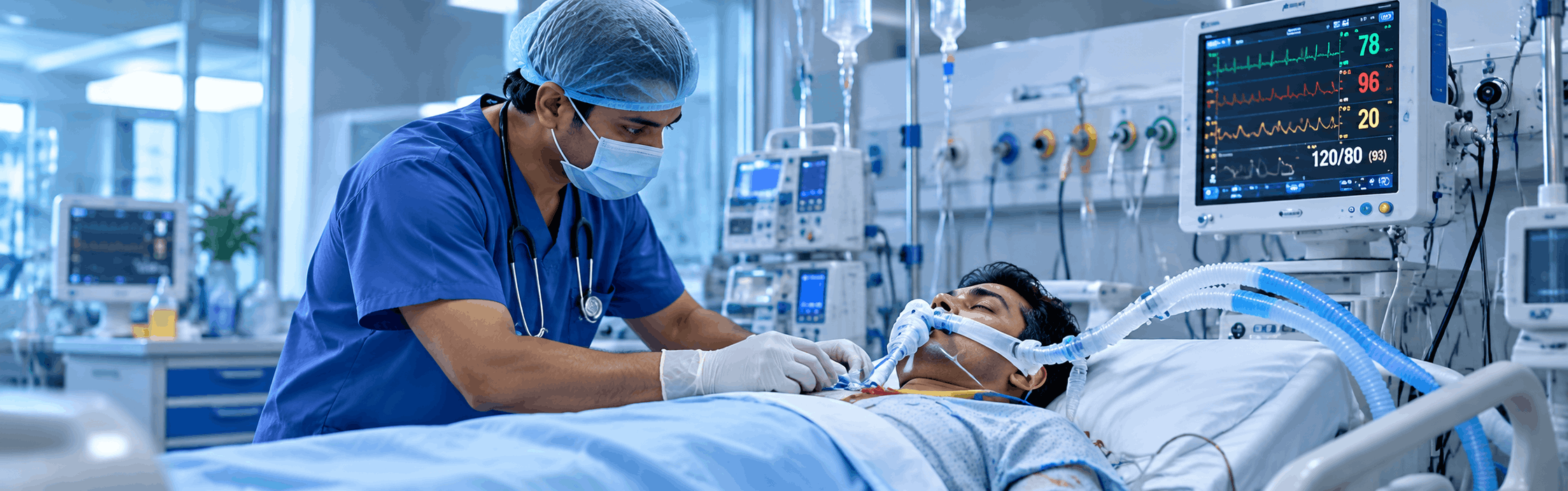
An intensivist-led unit taking medical, surgical, and transferred patients, with continuous monitoring at every bed. It is trusted as the best intensive care unit in South India by referring doctors precisely because the patients they send are rarely straightforward.
Coronary Care Unit
A dedicated cardiac unit for infarction, arrhythmia, heart failure, and post-intervention recovery, with rhythm monitoring at every bed and cardiology on site.
Ventilator Weaning and Tracheostomy Care
A structured programme for patients who have failed to come off the ventilator elsewhere, combining graded trials, sedation reduction, nutrition, and intensive physiotherapy.
Inter-Hospital and Inter-State Transfers
Our team speaks directly to the referring physician, agrees the plan, confirms the bed, and specifies the level of support required in transit. Families searching for a critical care hospital near me while their relative is admitted in another city are welcome to call our team before making any decision.
Second Opinion on Ongoing ICU Care
We will review records and imaging from another hospital and give an honest view on whether the current plan is right, whether recovery is realistic, and whether a transfer would help. Sometimes our advice is to stay where you are.
Planned Post-Operative Intensive Care
Beds reserved in advance for high-risk surgery, with the intensivist reviewing the patient before the operation. Surgeons across the region book into what they consider the best hospital for post surgery ICU care South India offers for their most fragile cases.
Rehabilitation and Discharge Planning
Physiotherapy, nutrition, swallowing assessment, tracheostomy training for relatives, and home care planning, all arranged before the patient leaves rather than after.
Support for Families Travelling From Outside Kerala
Guidance on accommodation near the hospital, insurance coordination, and consultant updates by phone for relatives who cannot be present every day.
Technology Judged by What It Prevents
Equipment matters most when it stops something happening. Each of the following exists to prevent a specific, common, avoidable harm.
Networked Beds and Central Monitoring
Prevents a deterioration from being noticed late. This is the practical substance of being a hospital with advanced ICU facilities South India physicians will send an unstable patient to.
Advanced Ventilation
Prevents the ventilator from injuring the lung it is supporting, through lung-protective settings and structured weaning protocols.
Non-Invasive Cardiac Output Monitoring
Prevents the over-administration of fluid, which is one of the commonest and most damaging errors in prolonged critical illness.
Point-of-Care Laboratory
Prevents treatment being adjusted on results that are already an hour out of date, with gases, lactate, and electrolytes resulted inside the unit.
Bedside Ultrasound and Echocardiography
Prevents an unstable patient being moved unnecessarily, since the imaging is brought to the bed instead.
Isolation and Infection Control
Prevents the hospital-acquired infection that undoes three weeks of recovery in three days, through audited line, catheter, and ventilator care. It is a large part of why we are known as the best ICU care hospital South India refers its long-stay patients to, and why an ICU equipped hospital South India can rely on must be measured on its infection rates and not its brochure.
How a Transfer or Admission Works, Step by Step
Most families reading this are managing a crisis from a distance. This is what we will do, and what we will need from you.
1. Call Us and Send the Records
Speak to our critical care team and send whatever you have: discharge summaries, scans, blood results, ventilator settings. We do not need everything. We need enough to form a view.
2. We Give You an Honest Assessment
Our intensivist reviews the case, speaks to the treating doctor where possible, and tells you plainly whether we believe we can help. If the answer is no, or if moving the patient would be more dangerous than staying, we will say so.
3. The Transfer Is Planned Before It Happens
The bed is confirmed, the level of support needed in transit is specified, and the receiving team knows the patient before the vehicle arrives. Nobody is put on the road on the assumption that a bed will be free.
4. Assessment and a New Plan on Arrival
The patient is reassessed completely rather than inheriting the previous plan unexamined. Within twenty-four hours you will have a documented plan, including a weaning target where a ventilator is involved.
5. Daily Briefings, Including by Phone
The treating consultant updates the family at a set time each day, and by telephone for relatives who cannot travel. Costs to date are reviewed with you as the plan changes.
6. Rehabilitation, Discharge, and Going Home
Physiotherapy, nutrition, tracheostomy training, and follow-up are arranged before discharge, and we remain reachable for your local doctor afterwards.
Frequently Asked Questions
Often, yes, but not always, and the honest answer depends on how stable they are. Send us the records and we will tell you whether the journey is safe and whether the move is likely to change anything. A transfer that a patient cannot survive is not worth making, and we will say so rather than accept the admission.
Speak to Our Critical Care Team Before You Decide
Whether you are arranging a transfer from another state, seeking a second opinion on a relative already in intensive care, or facing an emergency now, our team will talk to you and give you a straight answer.