

Best Hospital for Knee Replacement Surgery in Trivandrum
A knee gives way slowly. It begins with a hand on the banister, then a hand on the table to stand, then a walking stick that was only ever meant to be temporary. The Department of Orthopaedics and Joint Replacement at SP Fort Hospital, Trivandrum, was built around that slow decline and how to reverse it. Surgeons, anaesthetists, physiotherapists, and rehabilitation nurses write one plan between them, so patients are not sent from clinic to clinic collecting opinions that do not agree.
What that produces is a knee replacement surgery programme running as a single pathway from the first consultation to the last review, with modern implants, an ultraclean theatre, careful pre-operative workup, and walking on the day after the operation. Families comparing hospitals and looking for the best hospital for knee replacement surgery in Trivandrum usually find the difference lies in how the team works together, not in the equipment list.
The Consultants Who Will Treat You

Chief Consultant - Orthopaedics
MBBS, MS(Ortho)


Consultant - Orthopaedics
MBBS, DNB, D.Ortho

Consultant - Orthopaedics (Spine)
MBBS, MS (Ortho), DNB, FNB (Spine), FSS (USA)


Consultant - Pediatric Orthopaedics
MBBS, MS


Consultant - Orthopaedics
MBBS, DNB(Ortho)

A Worn Knee Does Not Repair Itself
The knee carries your whole body weight through surfaces lined with cartilage a few millimetres thick, and that lining has no blood supply of its own to heal with. When arthritis, injury, or long-standing inflammation strips it away, the loss is permanent. Bone then grinds on bone, the leg drifts out of line, the thigh muscle wastes because you stop using it, and a limp that was once occasional settles into your walk for good. Useful knee pain treatment starts with working out precisely what has failed inside the joint and how much of the surface is left. Surgery is not the answer for every painful knee. Where the cartilage is largely intact, the best treatment for knee pain is often weight reduction, a supervised exercise programme, an injection, or medication, and we will say so plainly. Our job is to tell you which stage you have actually reached, not to move you towards an operation. An orthopaedic doctor for knee pain should also be willing to look beyond the joint itself, because the same symptoms arrive from several directions. Sound treatment for knee joint pain depends on identifying the source before anything is prescribed.
When the Tablets No Longer Last the Day
Pain that wakes you at two in the morning, a walking distance that shrinks month by month, and painkillers that wear off before evening all point the same way. Conservative care has done what it can. Severe knee pain treatment at this stage means repairing the surface rather than managing the symptom, because no amount of exercise will grow cartilage back. A knee operation stops being the option of last resort and becomes the one that gives you your day back.
What Waiting Actually Costs
Patients often postpone the decision for three or four years and lose muscle, balance, and independence in that time. Waiting makes the operation harder and the recovery longer, since a wasted thigh and a stiffened joint take far more work to rehabilitate. Choosing the right moment gives a better result than choosing the last possible one.
Seven Reasons Patients Choose This Knee Replacement Programme
The implant is only a part. What decides the outcome is everything built around it. We have become the best hospital for knee replacement in Trivandrum that other doctors send their own patients and families to, and the reason is coordination rather than any single piece of technology.
A Single Plan, Agreed Between Us
Your surgeon, anaesthetist, and physiotherapist review you in the same sitting and commit to one plan. You will not be carrying films from one department to another, hoping the advice lines up.
Surgeons Who Operate on Knees Every Week
Regularity is what separates a good arthroplasty service from an occasional one, and it shows up in operating time, blood loss, and complication rates. The best knee replacement surgeon for you is one who does this procedure as routine work, which is how our consultants spend their operating lists.
The Implant Is Chosen for Your Knee
Bone quality, deformity, ligament condition, age, and how active you intend to be all feed into the choice. Knee joint replacement here draws on cruciate-retaining, posterior-stabilised, high-flexion, and constrained systems, so nothing is decided by what happens to be on the shelf.
Infection Is Kept Out of the Theatre
Laminar flow air handling, body exhaust suits, pre-admission screening, and disciplined antibiotic timing all target the one complication capable of ruining a technically perfect operation.
Pain Is Planned Before the First Incision
Nerve blocks, spinal anaesthesia, and a combination of drugs are decided in advance so that standing on day one is realistic. Controlling pain is what makes early rehabilitation possible, so we treat it as part of the surgical plan.
Physiotherapy Begins the Same Evening
Rehabilitation starts at the bedside, not in an outpatient queue three weeks later. The operation delivers half of your result, and the physiotherapy delivers the rest.
Physicians Are in the Same Building
Cardiology, diabetology, and internal medicine review the patients who need them without a referral elsewhere. That safety net is why older and higher-risk patients are directed to us as the best hospital for knee surgery in the region, and why orthopaedic care here extends past the joint to the person carrying it.
The Knee Problems This Department Treats
Replacement answers some knee problems and is the wrong answer for others. These are the conditions we see most often, and what we do about each.
Osteoarthritis of the Knee
Years of weight, work, and old injury thin the joint surface until walking hurts and the leg starts to bow outward. We begin with weight support, muscle strengthening, and medication, and we move to replacement when the X-ray shows the joint space has gone.
Rheumatoid and Other Inflammatory Arthritis
Inflammatory disease eats cartilage and bone from the inside and usually takes both knees together. Disease control comes first, and we time surgery with your rheumatologist so that it falls in a quiet phase rather than a flare.
Knees Damaged by Old Injury
A fracture that healed slightly out of position leaves an uneven surface that wears through far earlier than it should. These knees often need previous plates and screws removed, bone grafted, or alignment corrected before anything can be resurfaced.
Cartilage and Ligament Tears
A knee that locks, swells, or gives way after a twist usually has a torn meniscus or a ruptured cruciate ligament rather than arthritis. Knee joint damage treatment at this point is keyhole work aimed at saving the joint, which is why getting the diagnosis early is worth so much.
Bow Legs and Knock Knees
When the leg is out of line, one half of the knee takes a load meant for two and destroys itself first. Correcting that alignment is built into the replacement, and in younger patients an osteotomy can buy years before replacement is needed at all.
Knees That Will Not Bend or Straighten
Some joints lose the last few degrees of extension, and some will not bend far enough for stairs, a car seat, or sitting on the floor. Knee stiffness treatment can return movement to a knee that has been rigid for years, and patients frequently tell us that regaining the bend mattered more to them than losing the pain.
Bone Death at the End of the Thigh Bone
When blood supply to a segment of bone is cut off, that segment collapses and takes the joint surface with it. Caught early, the area can sometimes be saved. Once it has collapsed, the surface needs replacing with an implant chosen for your age and activity.
Implants That Have Loosened or Worn Out
A replacement can loosen, wear thin, stiffen, or become infected years after it was put in. Revision demands specific instruments, stems, augments, and judgement, and we keep all of them available rather than referring these cases away.
Infection Inside the Joint
An infected knee is destroyed within days rather than months. It needs urgent washout, antibiotics guided by culture, and reconstruction in stages. Nothing is gained by waiting to see whether it settles.
Pain at the Front of the Knee
Pain felt on stairs and slopes often comes from the kneecap and its groove rather than from the joint as a whole. A knee specialist doctor needs to separate those two before surgery is discussed at all, because their treatments have almost nothing in common.
Pain That Is Not Coming From the Knee
Hip arthritis, a compressed nerve in the lower back, and poor circulation in the leg all send pain to the same place. We examine those as part of every assessment, and it is a large part of why patients use us as an orthopaedic hospital for knee pain and not only as a surgical unit.
Replacement, Bone Health, and Rehabilitation in One Department
Knees seldom fail on their own, so the services a knee patient tends to need sit inside this department rather than behind another referral letter.
Total Knee Replacement
All three worn compartments are resurfaced together, and the leg is brought back into line. Total knee replacement remains the standard operation for arthritis that has spread across the joint, and our patients follow a rapid recovery protocol built around walking on day one.
Partial Knee Replacement
When only the inner or outer half has worn out, and the ligaments are sound, we resurface that half alone. The incision is smaller, the natural knee is largely preserved, and recovery is quicker in the patients who suit it.
Both Knees in One Admission
Where both knees have failed together and your heart and lungs allow it, we replace them under one anaesthetic. Total knee replacement surgery on this scale means a single recovery and a single course of physiotherapy instead of two, and we assess fitness for it honestly rather than assuming it.
Revision Surgery
Loosening, wear, instability, stiffness, and infection are dealt with in one stage or two depending on the cause. As a joint replacement hospital that keeps a full revision inventory, we plan these cases from detailed imaging well before the date.
Keyhole and Ligament Surgery
Meniscus repair, cruciate reconstruction, and cartilage procedures are done arthroscopically for younger and sporting patients. Advanced knee surgery includes knowing when a joint can still be saved instead of replaced.
Hip and Shoulder Replacement
The same consultants replace hips and shoulders, which matters when you have more than one worn joint and a sequence of operations to think through.
Bone Health and Osteoporosis Clinic
Density scanning, correction of vitamin D and calcium, and medication all lower the chance of the next fracture. Treating the bone matters as much as treating the joint sitting on it.
Rehabilitation That Continues After Discharge
Supervised physiotherapy carries on once you are home. Long-term knee joint care rests on it, so we count follow-up as part of the operation rather than an extra you can skip.
What Sits Behind the Operating Table
Arthroplasty rewards preparation more than improvisation. Imaging, implants, and theatre discipline are held to the same standard here so that every case is planned properly and delivered the same way. It is why advanced knee replacement surgery is available without travelling to a metro city, and why this works as a knee surgery hospital for complex cases as well as routine ones.
Laminar Flow Modular Theatres
Ultraclean airflow, restricted movement in and out, and dedicated arthroplasty lists cut infection risk. If you ask a hospital only one question about its facilities, make it this one.
Navigation and Pre-Operative Templating
Implant size, alignment, and ligament balance are worked out on calibrated images beforehand and confirmed with navigation during the procedure, so the operation is rehearsed before it is performed.
Imaging Under the Same Roof
X-ray, MRI, CT, and full-length alignment films are done on site, and most patients finish them within the same visit.
Implants Kept in Stock
Cruciate-retaining, posterior-stabilised, high-flexion, unicompartmental, and revision systems are all held here, so the implant is matched to the patient rather than the patient to the inventory.
Anaesthesia and Blood Conservation
Regional blocks, spinal anaesthesia, and tranexamic acid protocols reduce blood loss, lower pain scores, and keep most patients out of the transfusion pathway altogether.
Physiotherapy Gymnasium
Parallel bars, a practice staircase, static cycles, and gait training are all within the department, so rehabilitation happens before discharge rather than after it.
From the First Appointment to Walking Without Support
Patients who have already been through several opinions want to know what is going to be different here. This is the pathway in order.
1. Booking Your First Visit
Ring the front desk or use the form on this page to arrange a knee checkup. Bring old X-rays and scans, previous prescriptions, and a current list of your medicines, including anything for blood pressure, diabetes, or blood thinning.
2. Examination and Imaging
We assess movement, alignment, ligament stability, and the way you walk, then examine the hip and lower back above the knee. Weight-bearing X-rays are taken the same day. If surgery looks likely, blood tests, a cardiac review, and a dental check follow.
3. The Decision, Explained Together
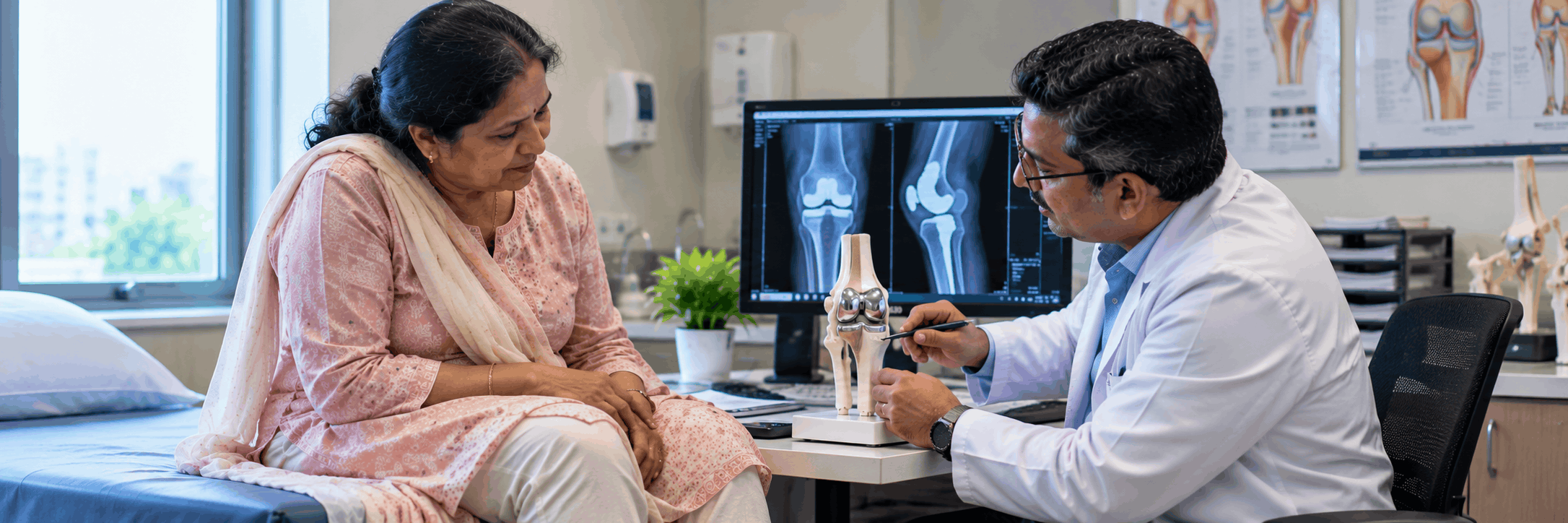
The surgeon, anaesthetist, and physiotherapist go through the findings with you in one conversation, including the option of waiting. You will see your own images on the screen while they are explained.
4. The Operation and Your Stay
A single knee joint replacement surgery usually takes around ninety minutes. Most patients are standing with support the following morning and go home between the third and fifth day.
5. Rehabilitation and Long-Term Review
Physiotherapy continues at home with reviews at six weeks, three months, and then yearly. At each visit we check the bend you have achieved, the position of the implant, and the condition of the bone around it.
Frequently Asked Questions
The figure depends on the implant, whether we treat one knee or both, and the room category you choose, so no single number applies to everyone. We give written estimates after assessment covering implant, theatre, stay, and physiotherapy, and the insurance desk tells you what your policy is likely to meet.
Talk to the Joint Replacement Team
Anyone typing knee surgeon near me or knee doctor near me into a search bar is usually some way past the point of managing on tablets. Our clinics run right through the week, and we take emergency referrals at any hour, so a search for knee replacement near me can end with an appointment this week rather than a waiting list.